
A persistent dry cough that wakes you up at 3:00 AM, a tight band across your chest after climbing stairs, or a faint whistling sound every time you breathe out—these warning signs are frequently dismissed across our district as “just chronic cold” or “seasonal dust allergy.”
When these episodes return week after week, they usually point to asthma: a long-term condition where the bronchial tubes inside your lungs become inflamed, sensitive, and narrow.
Living in Tirupattur brings specific challenges. Between seasonal harvest dust drifting across semi-rural pockets, transit pollution along key junction corridors, and smoke from local small industries, sensitive airways stay irritated. Finding timely, evidence-based asthma treatment in Tirupattur allows you to live without constant fear of your next flare-up.
What Actually Happens During an Asthma Episode?
Your lungs have airways resembling upside-down branches. In someone without asthma, air moves cleanly in and out. For individuals with hyper-sensitive airways, exposure to a trigger causes three rapid changes:
- Airway Swelling: The delicate mucosal lining becomes inflamed and thickens.
- Bronchospasm: The bands of smooth muscle encircling the airways constrict tightly.
- Mucus Hyper-secretion: Sticky mucus clogs the narrowed passage, forcing you to struggle for breath.
Recognizing Common Asthma Symptoms and Triggers
Asthma presents differently in every individual. Some struggle only during winter nights, while others deal with daily breathlessness.
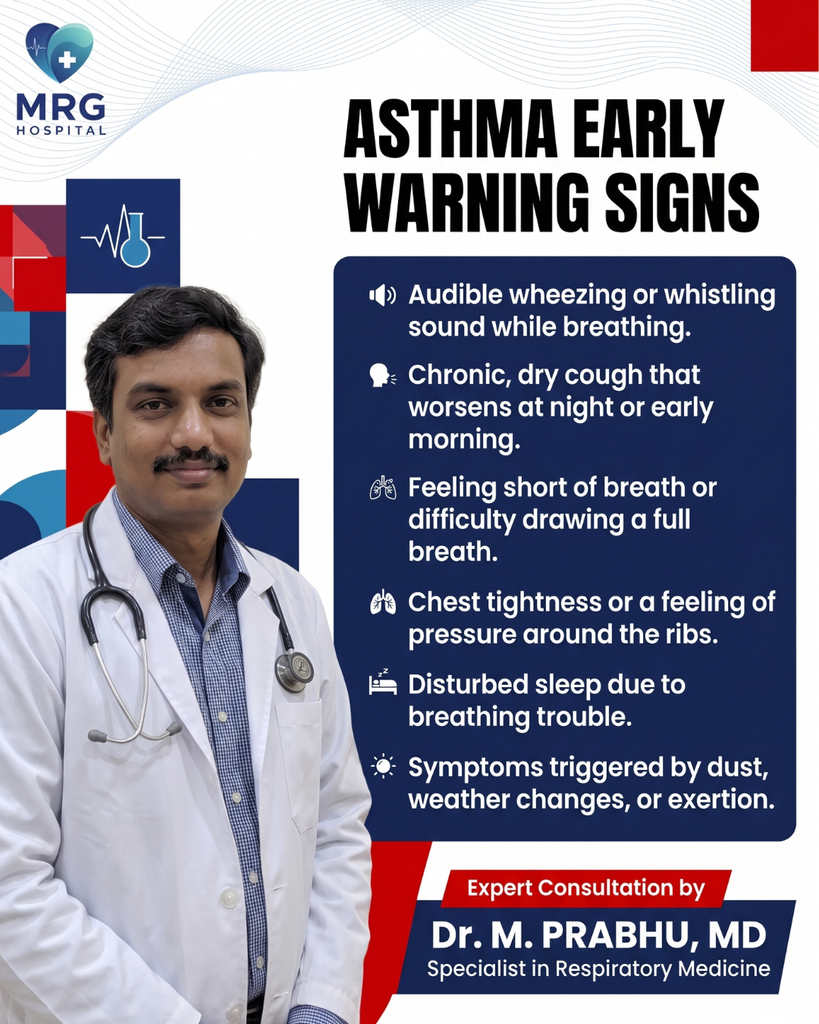
Key Symptoms to Watch For
Local Triggers Unique to Tirupattur and Nearby Areas
Identifying your specific triggers is half the battle:
- Agricultural & Pollen Dust: Airborne crop residue during regional harvesting periods irritates sensitive airways.
- Industrial & Workshop Irritants: Occupational exposure to leather tanning chemicals, fine wood dust, and silica particles in local workshop belts.
- Domestic Smoke & Biomass: Exposure to mosquito coils, wood-fired stoves, incense, and heavy diesel exhaust along main transit roads.
- Weather Shifts: Sudden drops in nighttime temperatures during monsoon and winter months, causing immediate cold-air bronchospasms.
How a Chest Specialist Diagnoses Asthma
Relying on physical symptoms alone is not enough. Conditions like chronic bronchitis, gastroesophageal reflux (GERD), and post-nasal drip can masquerade as asthma.
When you consult an experienced chest specialist in Tirupattur, the evaluation includes:
- Detailed Clinical History: Reviewing the timing of attacks, occupational hazards, and personal or family histories of allergies, eczema, or rhinitis.
- Spirometry / Pulmonary Function Testing (PFT): The gold standard diagnostic tool. You blow into an airflow sensor to measure your vital lung capacity and forced expiratory volume. The test is often repeated after an inhaled bronchodilator to confirm airway reversibility.
- Digital Chest Radiography (X-Ray): To evaluate structural lung health and rule out secondary infections or pneumonia.
Modern Management: Inhaler Therapy and Nebulization
There is a persistent myth that inhalers cause addiction or weaken the lungs. The clinical reality is the exact opposite.
Oral tablets and syrups must pass through your stomach, liver, and bloodstream before a tiny percentage reaches your lungs. In contrast, inhaler therapy and nebulization deliver micro-doses directly to inflamed bronchioles:
- Controller (Preventer) Inhalers: Taken daily—even when you feel completely fine. They use low-dose inhaled corticosteroids to quiet chronic inflammation, preventing attacks before they start.
- Reliever (Rescue) Inhalers: Fast-acting bronchodilators that relax airway muscles within minutes during sudden wheezing or tightness.
- Nebulizers: Ideal during acute distress or for young children and elderly patients who struggle to coordinate the breath-press timing of a standard meter-dose inhaler (MDI).
A Note on Technique: An inhaler only works if the medicine reaches your lower airways rather than coating your tongue or the back of your mouth. Always ask your respiratory physician or staff nurse to review your inhaler technique or recommend a spacer chamber if required.
When Asthma Becomes an Emergency
Asthma can deteriorate rapidly into severe respiratory failure. Do not wait it out at home or rely on home remedies if you notice:
- Inability to complete a short sentence without gasping for breath
- The skin pulling tightly between the ribs or at the base of the throat during breathing (retractions)
- Blue or gray discoloration of the fingernails or lips
- No improvement 15–20 minutes after using a reliever inhaler
Immediate access to 24/7 emergency asthma care with high-flow oxygen, continuous nebulization, and intensive care monitoring is life-saving during an acute exacerbation.
Advanced Respiratory Care at MRG Hospital, Tirupattur

You do not need to travel to Vellore, Bengaluru, or Chennai to access dedicated pulmonology infrastructure. MRG Hospital provides dedicated respiratory diagnostics and care right in Tirupattur.
Lead Pulmonology Specialist: Dr. M. Prabhu
- Designation: Specialist in Respiratory Medicine
- Qualifications: MBBS, MD – Respiratory Medicine
- Experience: 16+ Years of clinical expertise in chronic airway disease, asthma, and allergy management
- Languages Spoken: Tamil, English
- Consultation: Visiting Doctor (Prior appointment recommended)
(The hospital also includes respiratory specialist Dr. C. Murugan, MD Respiratory Medicine, ensuring multi-doctor evaluation for complex pulmonary cases.)
Hospital Infrastructure & Services:
In hospital infrastructure and services,
- we have specialized segregated respiratory ICU facility
- we have advanced mindray ventilator setup
- we have segregated suite rooms for COPD and asthma care with ventilator facility.
Frequently Asked Questions
Can asthma be cured permanently?
Asthma is a manageable chronic condition, not an infection that disappears with a single course of antibiotics. With consistent controller therapy and trigger avoidance, most patients achieve complete symptom control, exercise without limitation, and sleep through the night undisturbed.
Are inhalers habit-forming?
No. Inhalers are not addictive. They deliver localized therapy in fractions of the doses used in tablets. Stopping an inhaler because you “feel fine” causes underlying inflammation to build back up, which is why symptoms return.
Can children grow out of asthma?
Some children experience substantial symptom reduction as their airways widen and mature with age. However, early medical management is crucial to protect lung growth and prevent permanent airway remodeling.
Book Your Respiratory Consultation at MRG Hospital
If recurring breathlessness or an unexplained cough is disrupting your sleep or work, schedule a lung assessment today.
- Address: MRG Hospital, 347/5, Saibaba Nagar, Asiriyar Nagar, Teacher’s Colony, Pachchal, Tirupattur, Tamil Nadu – 635601
- Appointments & OPD Desk: +91 97872 67606
- 24/7 Emergency & Ambulance: +91 97912 90738 | +91 85248 66203 | +91 95856 78642